Let's Talk About Nitrogen Fixers!
- MJ

- Apr 18
- 8 min read
Updated: Apr 18

Nitrogen Fixing, Explained: How It Works (and How to Use It in North American Gardens)
Nitrogen is one of the biggest “growth drivers” in a garden. It’s a key ingredient in leafy growth, chlorophyll, and overall plant vigor. It’s also one of the nutrients gardeners most often feel like we’re chasing—through compost, fertilizers, manure, and constant amendments.
Nitrogen-fixing plants offer a different approach: invite living systems to do some of the work for you. Just sit back and let the soil and plants do the work for you!
But nitrogen fixing is also one of the most misunderstood garden concepts. It’s not magic, and it’s not instant. It’s a relationship—between plants and microbes—and the real payoff often comes later, when plants are cut back, drop leaves, go dormant, or die.
Let’s walk through what nitrogen fixing is, how it works, which plants do it in Canada and the US, and how to actually use them in both food forests and annual beds—without adding a bunch of extra work to your life.
What is nitrogen fixing?
Nitrogen fixing is the process of turning nitrogen gas from the air (N₂) into forms plants can use (like ammonium and related compounds).
Here’s the key:Even though our atmosphere is mostly nitrogen, plants can’t use nitrogen gas directly. They need nitrogen in plant-available forms, and that usually comes from:
decomposition of organic matter,
animal manures,
compost,
fertilizers,
or microbial processes in soil.
Nitrogen-fixing plants partner with specific microbes that can do the conversion.
How nitrogen fixing works

The main players: plants + microbes
Most nitrogen-fixing plants form partnerships with bacteria that live:
in root nodules (little bumps on roots), or
around the root zone (rhizosphere), depending on the plant group.
The plant provides the bacteria with sugars (energy).The bacteria provide the plant with nitrogen in usable forms.
It’s a trade agreement.
“Does the nitrogen leak out to nearby plants?”
This is where things get nuanced—and where a lot of garden myths live.
During active growth: small, real transfer can happen (but it’s limited)
While a nitrogen fixer is alive and growing, most of the nitrogen it gains is used by that plant. It’s building leaves, stems, roots, flowers—just like anything else.
That said, some nitrogen can move into the surrounding soil during the growing season through:
root shedding and root turnover (tiny root hairs die and regrow; small roots slough off),
root exudates (plants release compounds into the soil that feed microbes),
and mycorrhizal networks (fungal threads that connect plants and move nutrients and signals).
This transfer is usually modest, and it depends on:
soil life and fungal activity,
moisture and temperature,
how hard the nitrogen fixer is growing,
and whether it’s being cut back (which can stimulate root turnover).
So yes—there can be some “sharing,” but it’s not like a nitrogen fixer is constantly pumping fertilizer into the bed.
The big payoff: when the plant goes dormant or dies
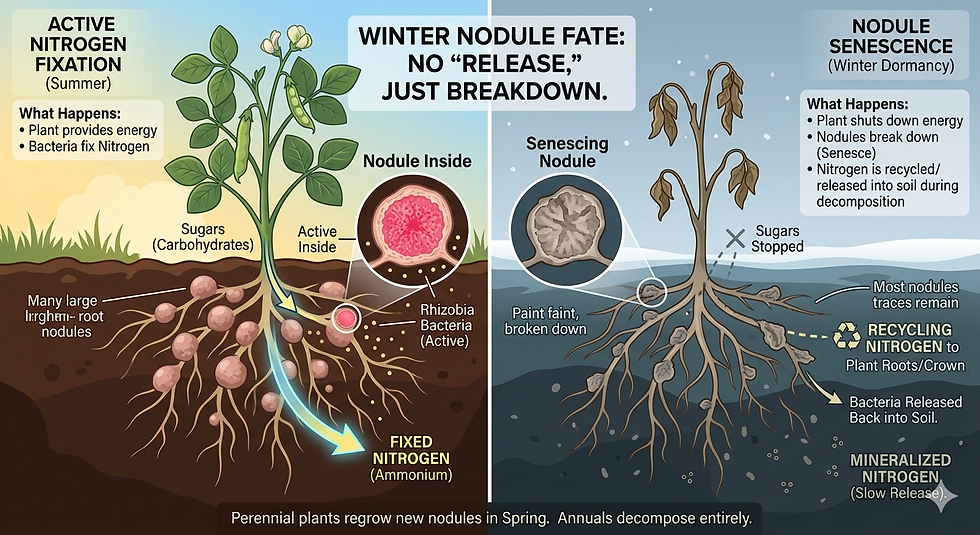
The most reliable nitrogen contribution happens when nitrogen-rich plant material becomes food for the soil:
leaves drop,
stems are chopped,
roots die back in dormancy,
or the whole plant is terminated (like a cover crop).
Then soil organisms break that material down, and nitrogen becomes available to other plants over time.
In other words: nitrogen fixing is often a future fertility strategy, not an instant fix.
Nitrogen-fixing plants
Nitrogen fixers in North America mostly fall into a few big groups:
1) Legumes (Fabaceae) — the biggest category
These include many garden cover crops, beans/peas, and a lot of shrubs and trees used in permaculture.

Annual legumes (great for beds and cover crops)
Peas (Pisum sativum) – cool-season; also edible
Beans (Phaseolus vulgaris) – warm-season; also edible
Fava/broad bean (Vicia faba) – cool-season; excellent biomass
Crimson clover (Trifolium incarnatum) – often grown as a cover crop
Berseem clover (Trifolium alexandrinum) – cover crop in some regions
Buckwheat (Fagopyrum esculentum) – often grown as a cover crop; also edible
Annual sweetclover (Melilotus spp.) – can be annual/biennial depending on species and climate (note: can be aggressive in some areas)

Perennial legumes (groundcovers, long-term soil builders)
White clover (Trifolium repens) – classic living mulch/groundcover
Red clover (Trifolium pratense) – often short-lived perennial/biennial
Alsike clover (Trifolium hybridum) – often used in cooler/wetter regions
Alfalfa (Medicago sativa) – deep-rooted perennial; drought-tolerant once established
Birdsfoot trefoil (Lotus corniculatus) – perennial; can be weedy in some contexts
Crown vetch (Securigera varia) – nitrogen fixer but often invasive; generally not recommended

Legume shrubs and trees (food forest favorites)
Siberian pea shrub (Caragana arborescens) – hardy shrub/small tree; common in cold climates
Black locust (Robinia pseudoacacia) – strong nitrogen fixer; can spread aggressively; use with care
Honey locust (Gleditsia triacanthos) – often listed as a nitrogen fixer; nitrogen-fixing ability is debated/variable by species and conditions (treat as “maybe,” not a guarantee)
False indigo / indigo bush (Amorpha fruticosa, Amorpha canescens) – shrub; region-dependent
2) Actinorhizal plants (non-legumes that fix nitrogen)
These partner with Frankia bacteria rather than the typical legume bacteria. Many are extremely useful in cold climates and tough sites.

Shrubs/trees commonly used in North America
Alders (Alnus spp.) – major nitrogen fixers; great for wet areas and restoration
Sea buckthorn (Hippophae rhamnoides) – hardy shrub; nitrogen fixer; can sucker/spread
Buffaloberry (Shepherdia spp.) – hardy shrub; nitrogen fixer; great for shelterbelts
Sweetfern (Comptonia peregrina) – low shrub; nitrogen fixer; acidic/sandy soils
Bayberry / wax myrtle (Morella pensylvanica / Morella cerifera) – nitrogen fixer; more common in milder/coastal regions
3) A special mention: cyanobacteria in aquatic systems
In ponds, wetlands, and some rice-like systems, certain cyanobacteria can fix nitrogen. For most home gardeners, the practical takeaway is: healthy aquatic edges and wetland plantings can support nutrient cycling, but this isn’t usually your primary “nitrogen plan.”
Nitrogen fixers by climate
Because Canada + the US covers everything from subarctic to subtropical, it’s more helpful to think in broad bands. Use these as a starting point, then choose species suited to your local conditions.
Cold/short-season regions (many of Canada; northern US)
Good fits often include:
Siberian pea shrub
Alders (especially where moisture is present)
Clovers (white/red/alsike depending on moisture)
Vetches (hairy vetch is common as a cover crop in many areas)
Fava beans (cool-season biomass)
Alfalfa (where it can establish; excellent drought resilience later)
Temperate regions (southern Canada; much of the US)
Many options work here:
Clovers, vetches, peas/beans
Black locust (with caution)
Sea buckthorn / buffaloberry (site-dependent)
Amorpha shrubs (region-dependent)
Alfalfa (deep-rooted fertility builder)
Dry regions (Prairies, interior west, drought-prone areas)
Look for:
Alfalfa (deep roots)
Siberian pea shrub (windbreak + tough)
Buffaloberry (hardy)
Certain clovers (with establishment support)
Drought-tolerant native legumes (often excellent, but species vary widely by region)
How to incorporate nitrogen fixers
Now that we know what they do and some examples of types of nitrogen fixers, lets go over some examples of how we can incorporate them.

1) As groundcover (living mulch)
Best for: food forests, around perennials, pathways between beds, orchard rows.
Examples:
White clover under fruit trees (mowed or scythed a few times a season)
Clover between raised beds to reduce mud and feed soil life
Birdsfoot trefoil in rougher areas (where appropriate and non-invasive)
How it helps:
shades soil (less evaporation),
feeds pollinators,
adds organic matter through mowing and root turnover,
contributes nitrogen over time.
Gentle tip: keep a “ring” of mulch right around young trees/shrubs so clover doesn’t compete at the trunk line while the plant is establishing.
2) Using live leaves as mulch (“chop-and-drop”)

Best for: food forests, perennial beds, around heavy feeders.
Examples:
Chop and drop clover or vetch around fruit trees.
Use leafy trimmings from pea shrub or sea buckthorn as surface mulch (where you’re already pruning).
This supports nitrogen cycling mostly through decomposition and soil feeding.
3) Using dead leaves (leaf drop as fertility)
Best for: shrubs/trees that naturally drop leaves; low-effort fertility.
Examples:
Let Siberian pea shrub leaf litter stay under the hedge line.
Use alder leaf fall as a “free mulch” in nearby beds (if you have access).
This is one of the lowest-energy ways to benefit: the plant does the work, gravity delivers it, soil life processes it.

4) Shredding branch trimmings for mulch (ramial wood + leafy chips)
Best for: food forests, shrub borders, perennial beds.
Examples:
Chip prunings from nitrogen-fixing shrubs (like pea shrub or sea buckthorn) and use as mulch.
Mix chipped twiggy material with greener leafy material for a more balanced mulch.
Note: woody chips are more carbon-heavy; they’re fantastic for moisture and fungal soil building, but they don’t act like a quick nitrogen fertilizer. Pairing them with leafy material or compost can keep things balanced.
5) Adding nitrogen fixers to compost
Best for: turning “green” material into stable fertility.
Examples:
Add pulled clover, vetch, or pea vines to compost as a nitrogen-rich “green.”
Add chopped alfalfa (if you grow it) as a powerful compost activator.
This is a great option if you prefer tidy systems or you’re managing weeds and want heat composting.
6) Turning it into the soil (cover crops / green manures)
Best for: annual beds, new garden areas, soil rebuilding.
Examples:
Spring: peas or fava as an early cover crop, then cut down before planting warm-season crops.
Late summer/fall: clover or vetch mixes to protect soil over winter (region-dependent).
Between crops: quick legume cover crop to keep soil covered and fed.
Gentle note: you don’t always have to “turn it in.” Cutting at the base and leaving roots in place can be easier on your body and kinder to soil structure. The roots decomposing in place are part of the nitrogen story.
7) Leave the roots in place (a low-effort nitrogen bonus)
Best for: annual beds, especially legumes like peas and beans.
When you harvest peas or beans, it’s tempting to pull the whole plant out. But if you cut the plant at soil level and leave the roots in the ground, you keep a lot of the nitrogen-fixing story right where you want it.
Those roots (and any nodules on them) become food for soil life as they break down. Over time, that decomposition helps build:
more organic matter,
better soil structure,
and a slow, steady release of nutrients for whatever you plant next.
How to do it (gentle version):
Snip stems at the base with pruners or scissors.
Leave the roots in place.
Compost the tops, or lay them down as mulch if they’re disease-free and not full of mature seeds.
This is one of those small practices that saves energy now (less pulling and digging) while quietly improving the bed for the next crop.
Using nitrogen fixers in food forests
Food forests thrive on long-term nutrient cycling. Nitrogen fixers can play several roles at once: fertility, mulch supply, pollinator support, wind protection, and microclimate building.
Roles nitrogen fixers can play in a food forest
Support species (fertility + biomass):Shrubs like Siberian pea shrub or sea buckthorn can be pruned for mulch.
Living groundcover: White clover or other low legumes can fill gaps, protect soil, and provide nectar.
Edge and windbreak plants: Nitrogen-fixing shrubs in hedgerows can reduce wind (less evaporation) and build soil along the edge.
Example food forest patterns
Fruit tree + clover understory + chop-and-drop: Clover grows under the dripline or in the walking paths; you mow/cut it a few times a season and leave it as mulch.
Support shrub ring: A fruit tree with a few nitrogen-fixing shrubs planted on the windward side (where appropriate), pruned periodically to provide mulch and reduce competition.
Wet-zone nitrogen fixing: Alders near a wet area or swale edge to stabilize soil and contribute fertility to a moisture-rich zone.
Using nitrogen fixers in annual garden beds
Annual beds are where people most want nitrogen right now. Nitrogen fixers can still help—but the timing matters.
Best uses in annual systems
1) Cover crops before or after vegetables
Grow a legume cover crop in the “shoulder seasons” (early spring or fall).
Terminate it (cut down) before it sets seed.
Leave roots in place; compost or mulch the tops.
2) Interplanting (small-scale, modest benefit)
You can interplant clover as a living mulch between wider-spaced crops, but it can compete for water in dry climates. If you try it:
use it where you can keep moisture steady,
keep it trimmed low,
and consider it more of a soil-cover strategy than a quick fertilizer.
3) Use nitrogen-fixing biomass as mulch/compost input
Even if you don’t grow nitrogen fixers in the bed, you can grow them elsewhere (paths, edges, a “fertility strip”) and bring the cuttings in as mulch or compost material.
This is often the most practical approach for tired gardeners: grow fertility where it’s easy, move it where you need it.
A gentle reality check
Nitrogen fixers help most when you think in seasons and years, not days.
The biggest nitrogen contribution usually comes through decomposition (tops and roots).
They’re most powerful when paired with:
mulch,
compost,
diverse plantings,
and soil life (fungi, bacteria, worms).


Comments